Skills-based hiring has gone mainstream. Roughly 70% of employers now say they hire for skills over credentials, and the language is everywhere: “degree not required,” “skills over resumes,” “we hire for capability.” And on its face, this is progress. A person who can actually do the work is worth more than a person who once studied something adjacent to it.
But here’s the uncomfortable follow-up question that rarely gets asked at the hiring stage: once you hire for skills you can’t verify on a resume, who builds and maintains those skills inside your organization?
Because skills-based hiring only works if internal training can back it up. When it can’t, you haven’t closed the skills gap. You’ve just moved it in-house, made it intangible on paper, and handed it to a training program that may not exist yet. That’s the collision playing out right now between hiring philosophy and learning infrastructure, and it’s widening what’s been dubbed “Learning Debt.”
Why does skills-based hiring create a training gap?
When you hire for a degree or a title, the credential acts as a proxy for a baseline of knowledge. When you hire for skills, you’re making a bet that the person either already has the skill or can develop it fast. Three things break when organizations adopt the first half of that philosophy without the second:
Skills are assumed, not verified. “Comfortable with data analysis” means something different in every job posting ever written. Without a shared, objective definition of what each skill means at each level, hiring managers pattern-match on keywords, and new hires get measured against a standard nobody wrote down.
Nobody owns the gap. In a credential-based world, the credential earned trust. In a skills-based world, trust has to be earned continuously, and that requires a system: assessments, refreshers, certifications, and a way to prove currency. Most organizations adopted skills-first hiring without building that system, so the gap floats between recruiting (“we hired what you asked for”), managers (“they should already know this”), and L&D (“we weren’t looped in”).
Technology keeps moving the target. Skills have a shorter shelf life than ever, especially in technical and AI-adjacent roles. A skill that was current at hire can be half-obsolete within a year or two. If training isn’t continuous, skills-based hiring becomes skills-based hiring as of one Tuesday in the past, and the gap quietly regrows from day one.
Industry research on skills-based hiring consistently finds that practice lags stated intent: organizations adopt the language of skills-first recruiting far faster than they build the internal development machinery to support it. The hiring side of the equation got an upgrade. The learning side, in many cases, is still running on a shared drive and good intentions.
What does the skills gap actually cost?
The costs are a reflection of learning debt, as this is where learning debt gets its start:
- Slower ramp time. Every new hire improvises their way through the parts of the job nobody trained them on, and the workarounds they invent become undocumented local tradition.
- False confidence in the org chart. If the skill was on the resume, leadership assumes it’s in the building. Nobody audits it, so the gap stays invisible until it surfaces as a missed deadline, a compliance miss, or a resignation.
- Turnover spiral. People hired for growth who don’t receive it leave, and the replacement search restarts the cycle, usually with the same missing piece.
For technology and software companies in particular, where product cycles reset the skills baseline every few quarters, this gap is structural, not incidental. As we covered in LMS for technology and software companies: onboarding and enablement, when the product changes constantly, the enablement system has to change with it, or every release quietly creates a cohort working from outdated mental models.
How do you close the gap after a skills-first hire?
The fix isn’t going back to resumes and degrees. It’s building the internal half of the skills-based model. Four moves do most of the work:
1. Define skills in operational terms. Turn “comfortable with data analysis” into concrete, assessable behavior: what someone at each level can demonstrably do. This is a writing exercise before it’s a software exercise, and it’s the foundation everything else sits on.
2. Assess at the moment of hire, not just before it. A short skills baseline inside the LMS during onboarding replaces assumption with data. The point isn’t to re-litigate the hiring decision; it’s to find out where each person actually starts so training targets gaps instead of repeating what they already know.
3. Build role-based paths that keep skills current. Because skills decay, the path can’t be a one-time onboarding sprint. It needs recurring refreshers tied to role, certification expirations that fire automatically, and new-product training that rolls out on the same schedule as the change itself. In Axis LMS, this is handled with role-based enrollment rules and automated certification expiration alerts, so currency is enforced by the system rather than by someone’s memory.
4. Verify continuously and make it visible. Regular assessments and a skills dashboard turn “I believe the team can do this” into “here’s the evidence.” Reporting matters as much as delivery here: completion means nothing on its own if assessment scores tell a different story. This is also what keeps the whole system audit-ready, since a skills program that tracks itself produces its own compliance record.
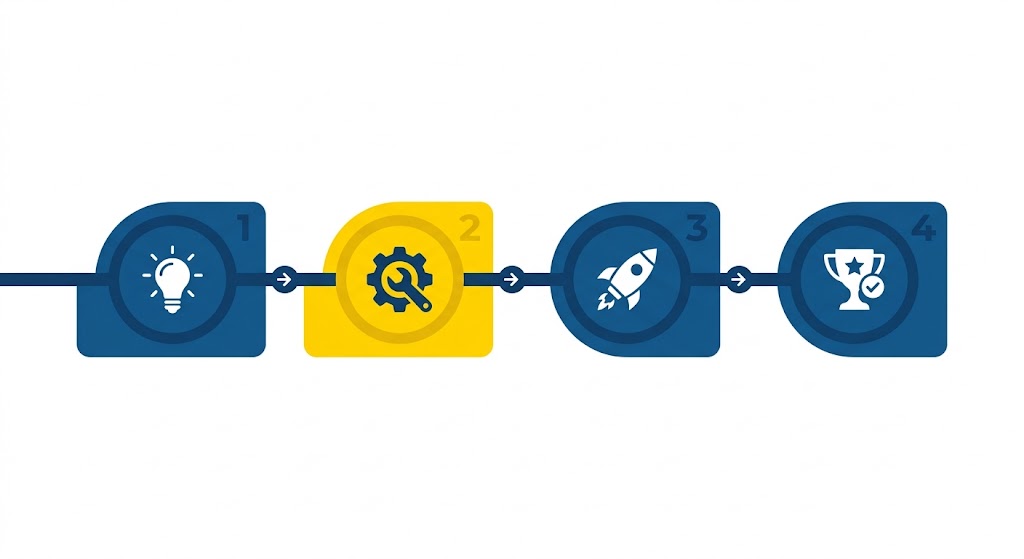
None of this requires rebuilding your hiring process. It requires acknowledging that hiring and learning are two halves of one system, and that the second half is usually the one that got skipped.
Can an LMS make skills-based hiring actually work?
It can, and this is really the dividing line between organizations where skills-first hiring is a strategy and organizations where it’s a slogan. The mechanics live in a few places:
- Onboarding paths per role, so day one starts with a skills baseline instead of assumption. Axis LMS lets you build these once and reuse them, which matters if you’re hiring continuously.
- Assessments that verify rather than annotate, so “can do” is a measured fact, and AI-assisted question generation makes it practical to build assessment coverage for every skill you’ve defined.
- Automated recertification and expiration tracking, so a skill that was verified at hire stays verified, with alerts before anything lapses.
- Reporting that ties skills data to roles, giving leadership a live view of organizational capability instead of a snapshot from hiring week.
One more point in favor of building on an established platform: the skills your organization runs on will keep changing, and the system underneath them shouldn’t. Atrixware has been building e-learning software for close to three decades, through several generations of training technology, and Axis LMS reflects that accumulated experience. When you’re standardizing something as central as how skills are defined, verified, and tracked, stability in the platform layer is worth something you can’t demo in a screen recording.
How do you know if your training is backing up your hiring?
A quick self-check. If you can answer these with data rather than impressions, your skills-based hiring has a functioning back half:
- Can you state, per role, which skills are required and who currently holds them?
- Do new hires complete a skills assessment within their first week, with results routed to their manager?
- Is there an automated signal when a required skill or certification approaches expiration?
- Can you show, without manual assembly, a record of who completed what training and when?
If the answers are coming up with a lot of blanks, the gap between your hiring philosophy and your training reality is growing every week. The good news is that closing it is a systems problem, not a culture problem, and systems problems have known solutions. Take the free demo and see what a skills-tracking workflow looks like when it’s running, or check the Axis LMS reporting capabilities to see how skills data surfaces in practice.
FAQ
What is skills-based hiring?
Skills-based hiring is recruiting that prioritizes a candidate’s demonstrated abilities over credentials like degrees or previous titles. Around 70% of employers now say they use it. It works best when paired with an internal system that verifies and develops those same skills after the hire.
Why does skills-based hiring increase training demands?
Because it removes the credential that used to serve as a proxy for baseline knowledge. When you hire on skills, the organization takes responsibility for verifying and maintaining those skills continuously, which requires structured assessments, refreshers, and tracking that most training programs weren’t built to provide.
How do you verify skills after hiring someone?
Run a skills baseline assessment during onboarding, map the results against role requirements, and assign targeted training to close the specific gaps. Then re-assess on a recurring schedule so skills stay current as the role and the technology around it change.
What tools help close a skills gap internally?
A learning management system with role-based learning paths, built-in assessments, certification expiration tracking, and skills-oriented reporting. The key is that delivery and verification happen in the same system, so skill claims and skill evidence never drift apart.
