Remote healthcare work is no longer a temporary arrangement for most organizations. Clinicians, intake coordinators, billing specialists, and patient support teams now deliver care and answer questions from home offices, satellite sites, and shared workspaces. That shift changes what training has to accomplish. The HHS telehealth best practice guidance points out that digital communication trainings help providers and other staff learn effective means of interviewing and examining patients virtually. A program designed around one conference room and one shift cannot carry that load. These are the practices that hold up in 2026.
Why remote healthcare training needs a different design
When a new hire sits in a clinic, a lot of learning happens by accident. They overhear how a colleague de-escalates a frustrated patient, watch how a chart note gets written, and absorb the rhythm of the front desk. Remote staff lose most of that ambient learning, so onboarding has to be deliberate about things that used to be absorbed.
Virtual training environments address part of the problem. They let critical education be completed risk-free, from anywhere, without the scheduling friction of gathering people in one building. Just as important, remote delivery reduces the technology burden on the learner, since practice happens in a controlled setting rather than live with a patient watching.
Anchor every curriculum to the platform your staff actually use
Effective telehealth training programs share a recognizable profile. They are modular, role-specific, simulation-driven, ongoing, measurable, and tailored to the specific telehealth platform in use. That last item is where a lot of programs fall short. Generic telehealth content teaches principles, but it does not teach your intake form, your escalation path, or your documentation fields.
Before writing a single lesson, document how your own system handles the workflows that matter: patient verification, virtual exam setup, charting, prescribing steps, referral handoffs, and after-hours escalation. Then build lessons around those steps. Training that mirrors the screen in front of the learner transfers faster than training that describes telehealth in the abstract.
Build modules, not marathons
Long live sessions are hard to schedule for anyone, and they are especially hard for remote staff who may be covering patient queues in between. Modular design lets you break a large curriculum into short, focused units that can be completed in a gap between appointments. A modular structure also makes updates cheaper, because you can revise the one lesson affected by a workflow change instead of rebuilding an entire course.
- Keep each module tied to a single competency or task.
- Pair short on-demand lessons with scheduled live sessions for discussion and questions.
- Sequence modules so new hires move from foundational workflows to edge cases.
- Tag modules by role so people only see what applies to them.
Match the content to the role
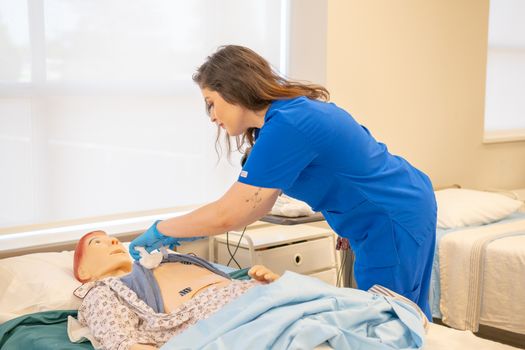
Role-specific training is one of the defining traits of a strong virtual care program, and it pays off because a scheduler and a nurse practitioner need very different things. A single curriculum for everyone wastes time for some learners and leaves gaps for others. Split the catalog by function, then layer shared modules on top, such as privacy practices, communication standards, and escalation rules.
| Role group | Training priorities |
|---|---|
| Virtual clinicians | Clinical communication, virtual interviewing and examination, documentation, empathy and emotional intelligence |
| Intake and scheduling | Customer service, patient verification workflows, digital communication, platform navigation |
| Supervisors and leads | Leadership development, team building, coaching remote staff, quality review |
| Growth and outreach staff | Sales conversations, service education, patient-facing communication |
That topic list is not arbitrary. Healthcare training providers commonly build programs around clinical communication, leadership development, customer service, team building, sales, documentation, empathy, and emotional intelligence, which maps closely to what distributed care teams need.
Use simulation for practice, not just for testing
Simulation-driven practice is one of the traits that separates programs that work from programs that merely check a box. New hires should rehearse a virtual visit, a difficult conversation, and an escalation before they handle any of those situations with a real patient. Simulation also gives trainers something concrete to coach against. A recorded practice scenario produces far more useful feedback than a quiz score.
Keep scenarios short and specific. One scenario for a patient who cannot get their camera working. One for a patient who becomes upset about a wait. One for a handoff that goes wrong. Repetition in a low-stakes setting is what builds the muscle memory that shows up under pressure.
Treat training as ongoing, not annual
An annual refresher does not match how fast virtual care workflows change. Platforms get updated, policies get revised, and new service lines appear. Ongoing training means a steady stream of small updates rather than one large event each year. Announcements, short refresher modules, and quick knowledge checks keep remote staff current without pulling them off the schedule for a full day.
This is also where simultaneous delivery matters. Organizations running mixed teams of remote and on-site care staff need a delivery platform that does not just tolerate remote participants but actively supports them, so both groups can train together on the same content at the same time.

Measure whether training changed anything
Measurable is on the short list of traits for effective telehealth training, and for good reason. Without measurement, you cannot tell whether a program is working. Track completion by role, assessment results, time to competency for new hires, and performance on quality reviews after training. If a module consistently produces poor assessment scores, the module is the problem, not the learners.
Reporting should be easy to pull and easy to read. Training managers need to see who is behind at a glance, and compliance or clinical leadership needs evidence that required education actually happened.
Keep certification and continuing education in the same system
Healthcare staff carry credential requirements that do not pause because they work remotely. Certification and continuing education tracking belongs in the same place as the rest of the training record, with expirations visible before they lapse rather than after. When certification tracking lives in a separate spreadsheet or a different tool, renewals get missed.
External resources can fill gaps in your catalog. The American Red Cross offers healthcare professional education programs that are science-based and cost-effective, and online healthcare certification training is available through partner programs such as the CareerStep offerings delivered in partnership with community colleges. Confirm current requirements with your state licensing body or the relevant certifying organization, since those rules change.

Choose delivery technology that serves everyone
The delivery platform decides how much of your design actually reaches learners. Look for the capabilities that matter for a distributed healthcare workforce:
- Mobile support, so staff can complete short modules from a phone or tablet.
- Communication tools such as messaging and announcements for policy updates and reminders.
- Reporting and analytics that show completion, assessment results, and credential status.
- Continuing education and certification tracking with expiration visibility.
- Course creation tools that let clinical educators update content without a developer.
- Branding and customization so training looks like your organization, not a generic portal.
- Integrations with HR and CRM systems to avoid duplicate data entry.
- E-commerce functionality if you also sell courses to external learners.
Common mistakes to avoid
Most weak remote training programs fail in predictable ways. Cramming every policy into the first week overwhelms new hires before they have context. Using one curriculum for every role wastes clinical time on scheduling content and leaves schedulers without the detail they need. Treating compliance completion as the whole of training leaves a team that is certified but not confident. Launching once and never revisiting content means the program drifts out of date within a year. Each of these is fixable with modules, role tagging, simulation, and a reporting habit.
Frequently Asked Questions
What topics should remote healthcare staff training cover?
Cover clinical communication, virtual interviewing and examination techniques, documentation standards, customer service, empathy, and emotional intelligence. Add leadership development and team building for supervisors, and sales or service education for outreach staff. Layer shared modules on privacy, escalation, and communication standards across every role so the whole team works from the same expectations.
How long should remote onboarding take for a healthcare role?
There is no single correct timeline because it depends on the role, the workflows involved, and the credential requirements attached to it. Build a modular sequence and let learners move at a pace that keeps quality high instead of forcing a fixed calendar. Confirm any required hours or certifications with your state licensing body or the relevant certifying organization.
Can remote and on-site care staff be trained together?
Yes, and many organizations prefer it. Running a single session for both groups keeps messaging consistent and avoids duplicate delivery. The delivery platform has to actively support remote participants rather than simply allow them to dial in, so test your setup with a real mixed group before committing to a schedule.
Why is simulation important for telehealth training?
Simulation lets staff practice virtual visits, difficult conversations, and escalations before a real patient is involved. Virtual training environments make that practice risk-free and repeatable from anywhere. It also gives trainers concrete behavior to coach, which produces better feedback than quiz results alone and shortens the gap between knowing a workflow and performing it.
How should we track continuing education for remote staff?
Keep certification and continuing education records in the same system that delivers the training, with expiration dates visible well before they lapse. Pull reports by role so supervisors can see who is due for renewal. Spreading records across spreadsheets and separate tools is the most common reason renewals get missed on distributed teams.
