Training fades when it is delivered once and then left alone. Decades of memory research, starting with Hermann Ebbinghaus in the 1880s, show that people forget most of what they learn within days, unless they revisit it at spaced intervals. Spaced repetition fixes this by scheduling short, deliberate re-exposure to material over weeks and months, and reinforcement (nudges, refreshers, quick knowledge checks) keeps skills active long after launch day. A learning management system makes that schedule practical: recurring assignments, automated reminders, re-certification windows, and reporting that shows whether knowledge is holding, or if ‘training’ was just a course being opened.
Why does training fade so fast?
Industry research on corporate learning consistently finds that learners lose a large share of new material within a month when nothing follows the initial course. The forgetting curve is steep at first: recall drops sharply in the first days, then levels off. Whatever survives that early drop is what sticks.
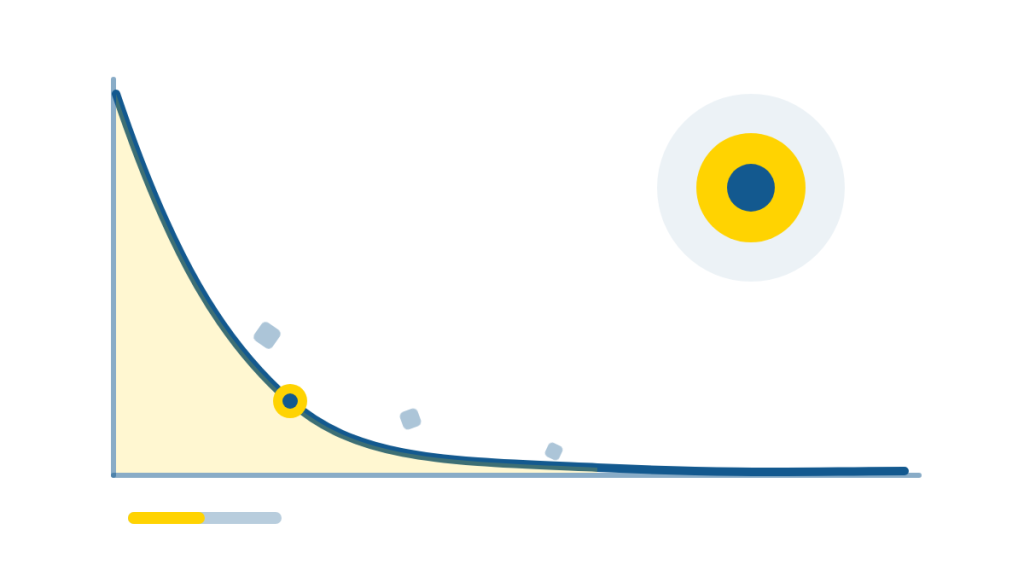
Three things accelerate the fade in a workplace setting:
- No application window. If a skill is not used on the job within days of training, the brain treats it as unused and lets it go. A course finished on Friday that will not matter on the job until next quarter is nearly guaranteed to fade.
- One-and-done delivery. A single long course, however well built, sends the implicit message that learning happened once. There is no built-in reason to return.
- Workload pressure. Even motivated learners shed optional revisits when deadlines crowd the calendar. If a refresher takes 45 minutes, it will lose to actual work every time.
The result shows up later as the know-do gap: people sat through the training, but when the moment comes to apply it, the steps are blurry. Workarounds fill in, habits drift, and the original course content recedes out of sight, retrievable only through search history.
What is spaced repetition, exactly?
Spaced repetition is the practice of re-exposing learners to material at expanding intervals: a quick review a few days after the course, another a week later, another a month out. Each successful recall at a wider interval strengthens the memory and slows the decay curve.
Two details matter more than the schedule itself:
- Recall beats review. Re-reading a slide deck does almost nothing. Answering a question, walking through a scenario, or reproducing a process from memory forces retrieval, and retrieval is what consolidates learning. Good spaced repetition is built from questions and scenarios, not replays.
- Short beats long. A three-minute knowledge check landing in someone’s queue outperforms an annual two-hour “refresher” nobody wants. Spacing only works when each touchpoint is small enough to actually happen.
This is also where spaced repetition differs from simply “retaking the course.” Retaking a course re-presents everything, which wastes time and signals distrust. Targeted refreshers target what the reporting says is actually slipping.
How do you build reinforcement into a training program?
The mechanics matter less than the commitment to automate them. Reinforcement that depends on someone remembering to send a follow-up will not survive a busy quarter. The pieces that hold up:
Break the course into reusable parts. Modern course creation tools make this straightforward: keep the full course for onboarding or initial certification, then rebuild its key points as short stand-alone refreshers. Drag-and-drop authoring and reusable question banks mean the second artifact takes a fraction of the time, because the assets already exist.
Automate the schedule. Use the LMS’s communication tools to do the remembering. Scheduled messages, email triggers, and course-completion-based follow-ups can fire a knowledge check three days after completion, a scenario exercise two weeks later, and a challenge quiz at the 60-day mark. Once the sequence is built, it runs for every learner who completes the course, indefinitely.
Anchor refreshers to real work. The best reinforcement questions mirror the situations where the training gets used: the approval step people skip, the form field people guess at, the escalation path nobody can name. Scenario-based checks beat definition matching, and they double as a diagnostic.
Put it where people already are. Mobile learning matters here more than anywhere else in the training program. A three-minute refresher that opens on a phone during a commute or between site visits actually gets done. One that requires logging in at a desktop between meetings does not.
Use windows, not just nudges. For skills with a compliance dimension, set re-certification windows and expiration alerts so the reinforcement loop has a hard edge. This keeps the refresh cadence tied to accountability rather than goodwill, and it builds the audit trail as a by-product. For a deeper look at what that evidence trail should contain, see What Does Audit-Ready Compliance Training Actually Look Like?
How do you know reinforcement is working?
Completion rates cannot answer this question, because they measure attendance, not retention. The signals worth watching:
- Score trajectories over time. Compare performance on the 3-day check, the 2-week check, and the 60-day check. Flat or rising scores mean the spacing is working; a steady slide means the intervals are too wide or the content needs rework.
- Question-level misses. If the same step trips people up in every cycle, that is a content or process problem, not a memory problem. Fix the source, not the schedule.
- Retake and remediation patterns. Rising first-attempt scores across cohorts are one of the clearest signs that reinforcement is compounding rather than merely repeating.
- Time between completion and application. Where integrations connect training data to the systems where work happens, you can start to see whether refresher timing lines up with when skills are actually exercised.
For a fuller treatment of the reporting side, see Measuring Learner Performance: Tying Training Data to Outcomes.
AI features are changing the upkeep side of this as well. Drafting fresh scenario questions for each cycle used to be the bottleneck that killed reinforcement programs; AI-assisted question generation and content updates shrink that work enough to keep the cadence alive. For a broader view of where AI fits into learning programs, see AI in Corporate Learning: Practical Uses for L&D Teams in 2026.
One more practical note: reinforcement programs run for years, and the automation behind them becomes part of the training operation’s infrastructure. Choosing tools and a platform built to keep schedules, records, and integrations working over the long term is part of the design, not an afterthought.
FAQ
How long after a course should the first refresher happen?
Within a few days. The forgetting curve is steepest immediately after learning, so the first touchpoint carries the most weight. A common pattern is a short knowledge check at 3 days, a scenario exercise at 2 weeks, and a broader challenge at 60 to 90 days, then alignment with re-certification windows for anything compliance-related.
Is spaced repetition the same as making learners retake the course?
No. Retaking re-presents all the material, which costs time and erodes goodwill. Spaced repetition uses short, targeted retrieval practice (questions, scenarios, decisions) aimed at what reporting shows is actually fading. Retaking is a last resort; recall is the default.
Does spaced repetition work for compliance training?
It works especially well there, because compliance content is exactly the kind that decays into checkbox familiarity. Spaced scenario checks keep the reasoning behind a rule active, and automated re-certification windows tie the reinforcement schedule to auditable records rather than to memory or goodwill.
How much time does each reinforcement touchpoint need?
Three to five minutes. If a refresher takes longer than a coffee break, completion rates will sag and the schedule will fall apart. Short is the point: spacing works through frequency, not duration.
What do you do when scores keep dropping despite refreshers?
Treat it as diagnostic information. Persistent drops on the same questions usually point to content that is unclear, a process that conflicts with the training, or material the role never actually uses. Adjust the content or the assignment rules before widening the schedule.
