Ask an AI chatbot to explain nearly any topic and you will get a clear, confident answer in seconds, free of charge. That reality has pushed a fair question across the training industry: if information is free, what exactly is a paid course worth? The short answer: a course is no longer selling information. It is selling structure, verification, and proof. The value of a paid course in 2026 comes from what AI cannot provide: a sequenced learning path, a credible record that a specific person actually mastered the material, and a credential that carries weight with employers, regulators, and clients.
This article breaks down where free AI answers fall short, which parts of a course buyers still happily pay for, and how course sellers can position their catalogs so the answer to “why pay for this” is obvious.
What Can AI Answer Well, and Where Does It Fall Short?
AI is genuinely excellent at explanation; it can define a term, summarize a regulation, walk through a formula, or generate a practice question in seconds. For the “what is it” layer of learning, free AI answers are often better than a poorly organized course, and buyers know it.
But explanation is not the same as education. AI answers fall short in four ways that matter to anyone selling structured learning:
- No accountability to accuracy. AI can produce a plausible answer that is subtly wrong or out of date, and the learner has no reliable way to tell. A course author who stands behind the material puts their reputation on every page.
- No sequencing. AI answers questions one at a time. It does not know what a learner should master first, what to skip, or where misconceptions typically form. Curriculum design, deciding the order, depth, and progression of a topic, is still a human judgment that buyers pay for.
- No verification. An AI chat cannot confirm that a specific person understands the material. It can quiz, but it cannot proctor, score consistently, issue a credential, or stand behind the result.
- No record. When a manager, auditor, or client asks “who completed this and when,” a chat history is not evidence. Learning that leaves no record is, in practical terms, learning that did not happen for compliance or hiring purposes.
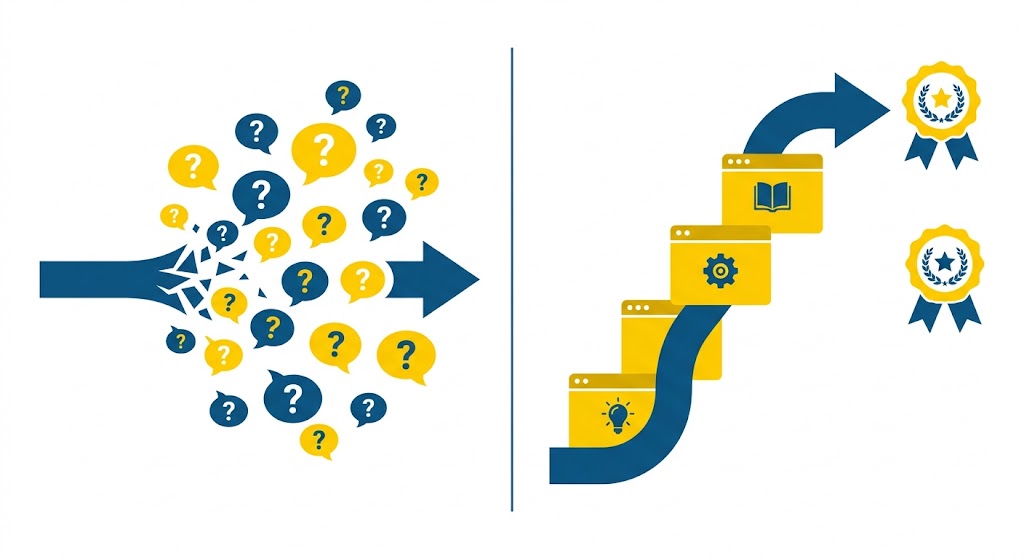
In other words, AI has commoditized the answer, not the outcome. The outcome, a verified, credentialed, tracked person who can do the job, is still scarce, and it is still what people and organizations pay for.
What Are Buyers Actually Paying For in a Paid Course?
Strip away the content itself and a well-built paid course delivers five things a free chat session never will:
- A curated path. Someone with real expertise decided what matters, in what order, and what can be ignored. That curation is the product.
- Assessment that means something. Quizzes, scenario tasks, and final exams with consistent scoring turn “I read about it” into “I was tested on it and passed.”
- A credential that others recognize. A certificate tied to verified completion is portable proof. It is what gets attached to a résumé, shown to a client, or filed for an audit.
- Recency and accountability. Courses get updated, versioned, and re-certified. A responsible provider tracks which version of the material a learner completed, which matters enormously in regulated or fast-moving fields.
- Support and community. Structured programs pair content with instructors, discussion, feedback, and deadlines. Deadlines alone are worth real money; they are the difference between intending to learn and actually finishing.
Notice that none of these five depend on the information being secret. They depend on the information being organized, verified, and certified. That is why the “AI answers everything” era does not eliminate the market for paid courses. It instead filters it. Courses that only repackage information are exposed. Courses that deliver structure and proof are more valuable than ever, because the free alternative now sets the floor for what information alone is worth: roughly zero.
How Should Course Sellers Position Their Catalogs in the AI Era?
The practical question for anyone selling training is how to respond. Three positioning moves stand out.
Sell the outcome, not the content
Price and market the credential, the capability, or the compliance result, not the hours of video. “Prepare for and pass X” or “get your team certified on Y” is a claim AI cannot undercut, because AI does not issue credentials. Descriptive titles that merely summarize topics (“An Introduction to Z”) now compete directly with a free chat window. Outcome-titled courses do not.
Make certification and evidence the core product
If certificates are currently an afterthought in your catalog, that is the single highest-leverage change to make. Bundling courses with certifications raises perceived value and order size, and it gives buyers something that survives the “I could have asked AI” objection. For a deeper look at how to structure bundles around certificates, see our piece on Bundling Courses and Certifications to Raise Average Order Value. The same logic applies to continuing education requirements, where the credit, not the reading, is what the buyer needs.
Make sure the buying and learning experience feels worth paying for
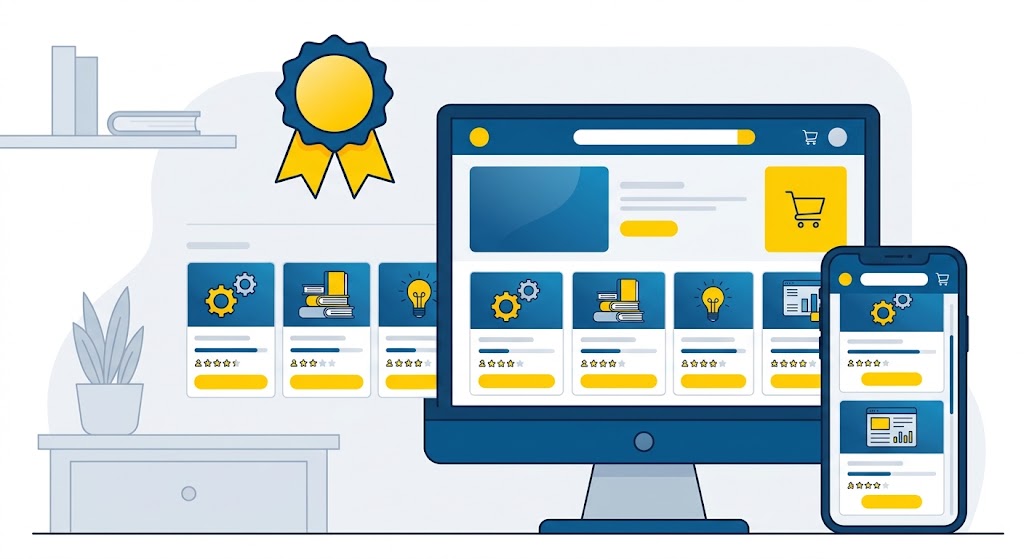
Buyers judge the value of a paid course within minutes of logging in. A clunky checkout, a confusing catalog, or a course that does not work well on a phone all suggest “this could have been a free video.” On the other side, a clean catalog, one-click purchase, mobile-friendly lessons, and visible progress make the paid experience feel categorically different from asking a chatbot. Your storefront and your course delivery together are the answer to “why pay for this.”
What Role Does the LMS Play in Selling Learning That AI Cannot Undercut?
An LMS is the machinery that turns content into a product with proof attached. This is where the platform choice matters more in 2026 than it did five years ago.
- E-commerce that sells outcomes. Selling courses online requires clean product pages, bundles, coupons, and payment handling, all connected to enrollment. Selling Online Courses with an LMS: A 2026 Revenue Playbook covers the mechanics of turning a catalog into predictable revenue.
- Assessment and certification engines. Built-in quizzing, exam logic, and automated certificate issuance are what convert completion into a credential buyers can trust.
- Reporting that proves value. Detailed progress, score, and completion reporting lets sellers show customers exactly what their teams learned, and lets B2B buyers justify renewals. Proof of learning is a feature, not an admin chore.
- Mobile learning. Buyers complete training on phones, between jobs, on job sites. If the paid experience is worse than a free chat on the same device, the sale will not survive.
- AI where it helps the seller, not replaces them. Modern AI features, like assisting with course building and question drafting, cut production time so sellers can compete on curation and updates rather than raw content volume. Axis LMS includes AI-assisted course authoring for exactly this reason.
- Communication that drives completion. Automated reminders, announcements, and messaging are what push a purchaser across the finish line, and completion is what earns renewals and referrals.
Axis LMS was built around this model: drag-and-drop course creation, e-commerce with bundles and certificates, robust reporting, communication tools, and mobile-ready delivery, so the credential and the experience, not the raw information, carry the value. And because the platform behind those credentials has been evolving for decades, certificates issued today will still be verifiable years from now, which is exactly the kind of durability buyers of credentials should be asking about.
What Should You Do This Week?
A short checklist for repositioning a catalog in the AI era:
- Audit your titles. Flag every course that sells information (“Introduction to X”) rather than an outcome or credential. Rewrite the five most important ones around results.
- Attach certificates where none exist. Even a simple completion certificate with a verifiable record changes the value story.
- Bundle deliberately. Group courses into role-based or certification-path bundles that raise order value and give buyers a clear destination. The bundling guide above has the playbook.
- Test your own checkout and mobile experience. Buy one of your own courses on a phone. Any friction you find is a direct answer to “why should I pay for this.”
- Use AI to update, not to replace. Let AI features accelerate authoring and question writing so your catalog stays current, which is something free answers never promise.
FAQ: Selling Paid Courses in the AI Era
Why would anyone pay for a course when ChatGPT-type tools answer questions for free?
Because explanation and education are different products. Free AI answers provide explanation on demand, but they do not sequence material, verify learning, issue credentials, or keep records. Paid courses sell structure, assessment, certification, and proof of completion. As free information becomes universal, those elements become the entire basis of the purchase.
Will AI eventually replace online courses completely?
AI will keep absorbing the pure-information end of the market, which is already happening. It will not replace assessment, certification, records, or accountability, because those require an institution that stands behind a result. The realistic future is AI-assisted course production inside structured programs: AI speeds up content creation while the course provider owns verification and the credential.
How do I price a course when so much information is free?
Price the outcome and the proof, not the content volume. Certificates, live components, feedback, and compliance records all support premium pricing because they cannot be replicated by a free chat session. Bundling courses into certification paths also supports higher order values than selling individual information products.
What features matter most in an LMS for selling courses?
The short list: integrated e-commerce with bundles and coupons, automated certification, assessment and exam tooling, detailed completion and score reporting, mobile delivery, and automated communication like reminders and announcements. AI-assisted authoring is increasingly valuable for keeping catalogs current. A platform like Axis LMS bundles these so the seller’s effort goes into curriculum and positioning rather than duct-taping tools together.
Are certificates still worth anything if AI makes content free?
More than ever. When information is abundant, verification is the scarce asset. A certificate is only as valuable as the tracking and records behind it, which is why credential-issuing platforms matter: the certificate is backed by an auditable record of what was completed, when, and at what score.
