From Binders to Boards: Surviving 30 Years of Market Volatility
In the last 30 years, financial services have shifted from physical ledgers to instant, liquid networks. This article explores how training evolved from a back-office requirement to a front-line strategic weapon, and why an Learning Management System (LMS) is now the heartbeat of institutional resilience
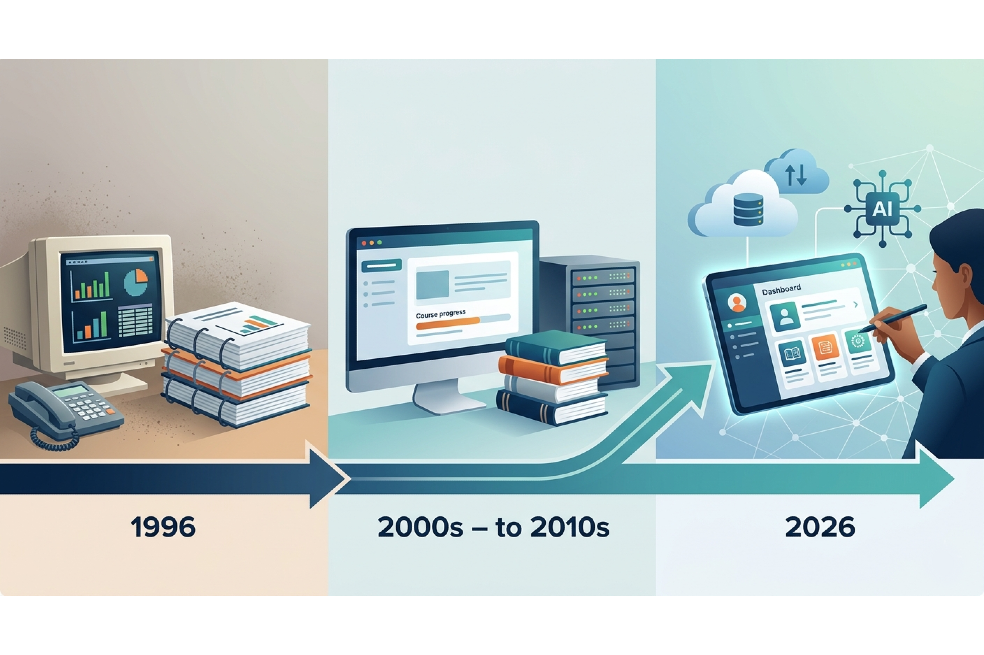
The 30-Year Knowledge Pivot
Thirty years is a lifetime in the financial world. In 1996, online banking was a fringe experiment. If you wanted to trade a stock, you usually called a person on a landline. Professional development was similarly tethered to the physical world; usually via a three-ring binder in a windowless conference room where a subject matter expert talked at you for eight hours.
Fast forward to 2026: we operate in a borderless, fully digital ecosystem where fintech agility and traditional banking stability have merged into a single, always-on experience. But the true story of this era isn’t just about the shift in currency, but moreso the rapid acceleration of knowledge. As the industry transformed, the systems used to train its people had to do more than just keep pace, as they were quickly becoming the backbone of would-be institutional standards.
Looking at the three defining decades spanning 1996 and 2026, e-learning gave the industry the tools to react to disruption-driven compliance, as well as the necessary tools to survive them.
The Birth of Knowledge Liquidity
The late 90s were defined by the Wild West of the early internet. As the dot-com boom took hold, the financial industry, already familiar with the nature of risk, faced a unique threat at the new, breakneck pace risk could take. The first online-only platforms, like E*TRADE and the early iterations of PayPal, began to challenge the traditional brick-and-mortar logic.

24/7 Exposure
For the first time, a market could move in seconds, rendering a three-month printing cycle for training manuals not just slow, but dangerous. Early online banking meant 24/7 exposure to a global market. This introduced digital fraud, phishing, and cybersecurity risks that old-school security protocols weren’t designed to handle. If an advisor didn’t understand the risks of a new economy stock in real-time, the firm’s capital was at risk.
From Silos to Scalability
This era saw the birth of the first Learning Management Systems (LMS). Early systems could be described clunky by today’s standards; delivered via CD-ROM or dial-up connections, but they represented a massive pivot: moving from physical knowledge (stored in a person’s head or a book) to accessible data.
This was the era where SCORM (Sharable Content Object Reference Model) became the industry standard, allowing different training modules to talk to different systems. It allowed for the first wave of what we’ll call “Knowledge Liquidity”, or the ability to move expertise across a global organization at the click of a button.
Standardization as Survival
Firms realized that survival depended on the ability to push synchronized updates to a global workforce instantly, moving away from senior parter shadowing, and into the age of digital standardization. By 2005, the goal was simple: ensure that every employee, whether they were in a New York skyscraper or a rural branch, operated from the same digital playbook.
From HR Perk to Regulatory Shield
If the dot-com era was about speed, this decade was about accountability. The 2008 financial crisis was a systemic shock that fundamentally broke public trust. The legislative response, headlined by Dodd-Frank in the U.S. and Basel III internationally, transformed training from a human resources perk into a legal imperative.
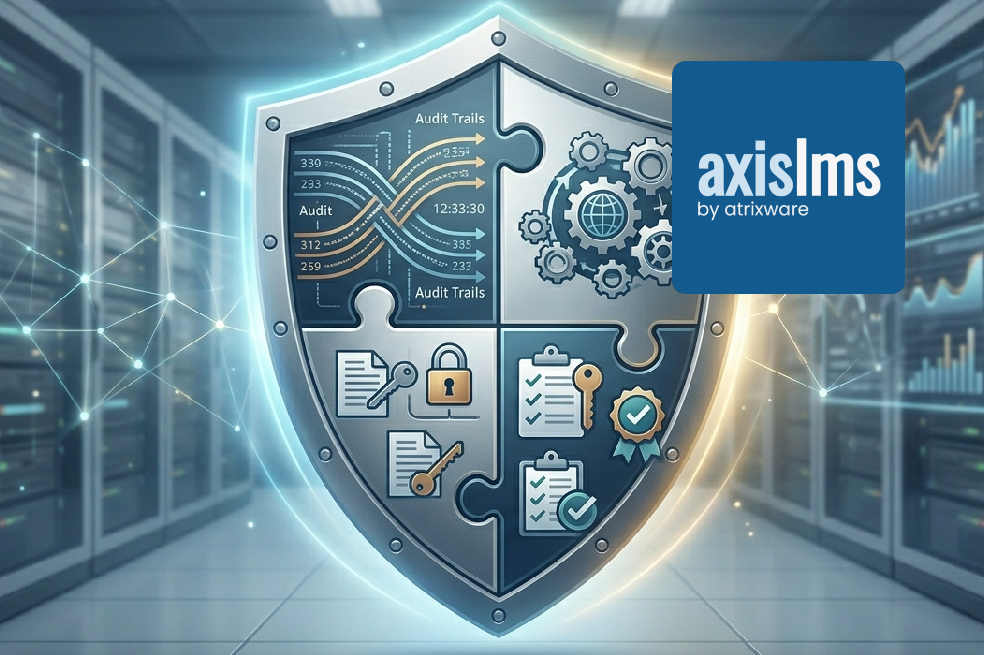
The Cost of “I Didn’t Know”
After 2008, “I didn’t know the policy” became a billion-dollar liability, and compliance was no longer a box to be checked. Enforced industrial compliance became a survival necessity. Regulators didn’t just want to see a signed piece of paper, and instead required proof of a culture of compliance. This required constant, verifiable education on Anti-Money Laundering (AML) and Know Your Customer (KYC) protocols. Paper-thin compliance was on its way out.
The System of Record
This is when the LMS moved from the back office to the front line: it became the System of Record. E-learning transitioned into a sophisticated audit tool, providing the digital breadcrumbs required by global regulators.
We saw the rise of verifiable competency, as it was no longer enough to click next through a slide deck. Systems began incorporating interactive branching scenarios and rigorous assessments to prove mastery. During this period, the LMS also began its migration to the cloud, allowing for the first mobile-ready training as the iPhone and iPad changed how professionals accessed information outside the office.
Bridging the Global Gap
Consistency became the primary goal. Large institutions used e-learning to bridge the gap between their international offices, ensuring a unified response to a volatile regulatory landscape. In many cases, if it wasn’t tracked and timestamped in the LMS, the training didn’t happen.
The Era of Precision Upskilling
By 2016, we entered the fintech era, but by 2026, that distinction has vanished. Every bank is now a tech company. With the rise of instant payment networks like FedNow and the shift toward T+0 (real-time) settlement, the half-life of financial knowledge has never been shorter.

The Flow of Work
If the thrill of an 8-hour seminar isn’t dead, it is on its last stand. Modern financial field agents to analysts must learn in the flow of work. As AI begins to automate routine decisions, the human element of finance has shifted toward high-level strategy and complex relationship management.
The Rise of the LXP and Microlearning
Today’s ecosystems have evolved from the LMS into the Learning Experience Platform (LXP). These systems use AI to identify individual knowledge gaps before they become liabilities.
- Microlearning: Instead of a 60-minute module, an advisor consumes a 3-minute video on a new digital asset regulation between client meetings.
- Blended Learning: We’ve realized that digital isn’t a replacement for human interaction, but an enhancer. Successful firms use blended models—using the LMS for foundational knowledge and quick updates, while reserving in-person time for high-stakes coaching and soft-skill development.
Training as a Competitive Advantage
In 2026, sophisticated e-learning is a competitive advantage, where the firms winning market share are those that can reskill their teams on emerging technologies faster than their peers. Training is no longer a back-office cost center; it is the engine of agile innovation.
30 Years of Tech Evolution
| Era | Focus | Primary Tool | Key Risk |
| 1996–2005 | Scalability | Early LMS / CD-ROM | Market Speed & Fraud |
| 2006–2015 | Accountability | Cloud LMS / Audit Trails | Regulatory Failure |
| 2016–2026 | Agility | LXP / Microlearning | Knowledge Decay & AI |
Conclusion: Your Ability to Learn is Your Only Edge
The trajectory of the last 30 years is undeniable. What started as an effort to digitize the binder has evolved into the digitizing the professional.
- The Dot-Com Era built the digital foundation.
- The 2008 Crisis turned digital training into a mandatory shield.
- The Fintech Era turned learning into a strategic weapon for growth.
As we look toward the next decade, the most successful institutions won’t just be the ones with the most capital, but those with the most versatile and adaptable talent. In the financial landscape, your ability to learn, and master new tools is your an irrefutable edge on the competition.
