
In 2026, volatility has settled in as the new norm. Between shifting supply chains and the relentless pressure to implement rapidly evolving technology, businesses are facing an onslaught of “faster-than-ever” change.
While there were once market constants we could plan around, today, solid footing is a tangible advantage. Companies that maintain stability amidst the chaos don’t just survive; they lead. By prioritizing operational, workforce, and knowledge stability, organizations can adapt with precision rather than panic. This is where a long-tenured Learning Management System (LMS) partner becomes a strategic cornerstone.
Preventing Knowledge Loss: Stabilizing the Manufacturing Workforce
The nature of skilled labor has always applied pressure to turnover rates, but a shifting cultural focus has lowered interest in traditional development. This has created a “knowledge gap” between two distinct groups:
- The Veterans: An aging workforce of experienced workers who are retiring or nearing retirement.
- The Newcomers: A younger, more inexperienced generation exploring where their skills fit.
As seasoned workers exit, the loss of decades of institutional memory poses a significant risk. Without a stable transfer of knowledge, industries face:
- Decreased Output: Loss of “tricks of the trade” that maintain efficiency.
- Exaggerated Safety Risks: Critical safety nuances that aren’t found in a basic manual.
- Training Stagnation: New hires learning from incomplete or outdated processes.
To shrink this divide, companies must create a central knowledge hub. By allowing retiring workers to give input on its development, you ensure the next generation inherits the fundamentals. Like any master craftsman knows, you need a stable foundation to build upward.
In a market currently flooded with AI-first startups promising ‘radical disruption’ and ‘instant automation,’ it is easy to be swayed by the newest tool. But for a business seeking stability, ‘disruption’ is the last thing you need. Unlike a venture-backed newcomer that may pivot its entire business model by the next fiscal quarter, a longstanding LMS partner offers the ‘adults in the room’ perspective. When the goal is to safeguard your company’s institutional memory, the permanence of an established partner ensures your knowledge hub is a fortress, not a beta test.
The ROI of Reliability: Avoiding the ‘Technology Churn’ Cycle
Operational stability is the silent engine of efficiency. In the rush to adopt “cutting-edge” AI solutions, many organizations inadvertently fall into technology churn: frequent tool changes that promise optimization, but deliver distraction.
| The AI-First Startup | The Long-Tenured LMS Partner |
| “Radical Disruption” as a core value. | Reliability as a core value. |
| Frequent pivots based on venture capital. | Predictable roadmaps based on market cycles. |
| High cognitive load for staff (constant relearning). | Invisible support that reduces friction. |
| “Move fast and break things” mentality. | “Battle-tested” onboarding playbooks. |
Every “pivot” from an unproven startup represents a spike in downtime and a blow to morale. Software should be an invisible support, not a constant variable. When employees trust that their tools won’t disappear or fundamentally change overnight, they invest the time required to master them. This psychological safety leads to a higher “utilization ceiling,” weaving the LMS into the company’s DNA rather than keeping it a superficial add-on.
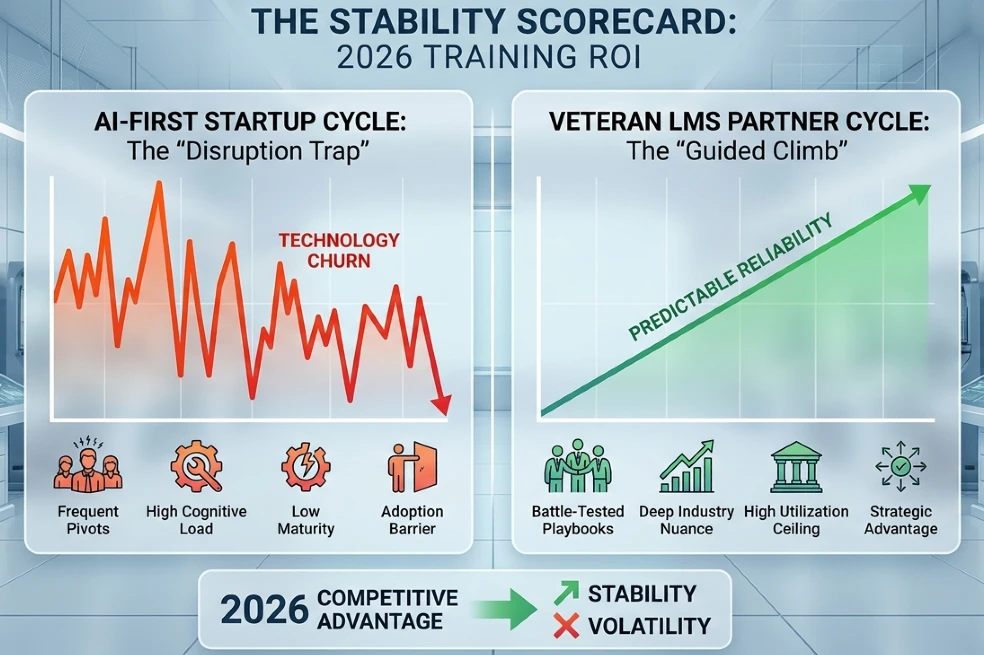
The irony of many AI-first startups is that while they move fast, they often leave their clients behind during the onboarding process. Veteran LMS partners, by contrast, provide battle-tested playbooks for onboarding new technologies that account for the human element of change management. Because they have navigated countless industry shifts, they can anticipate friction points before they occur, ensuring that your team can adapt to new features without the traditional “disruption dip.” In this model, evolution is a guided climb rather than a leap into the dark.
Scaling Your Strategy: Capturing Institutional Memory as an Asset
In manufacturing, knowledge is more than just data; it is a critical operational asset. The “tribal knowledge” held by a master technician is the glue that holds a production line together during a crisis. A stable partnership ensures that this intellectual capital is treated with the same rigor as physical inventory: tracked, preserved, and distributed.

There is a common misconception that stability is the enemy of agility. In reality, a stable ecosystem is what enables a company to pivot. When your workforce processes and technological foundations are solid, knowledge flows freely. You can adapt to supply chain disruptions with surgical precision because the “how” of the work is already solved.
Redefining Innovation: Why Stability Wins in 2026
In 2026, the definition of “innovation” has shifted. While the market often favors the flash of AI-first startups and the promise of radical disruption, true agility is only possible when it is built on a bedrock of stability. For the manufacturing sector, the risks of “moving fast and breaking things” are simply too high when applied to institutional knowledge and safety-critical workflows.
By investing in workforce, process, and technology stability, organizations don’t just insulate themselves against current volatility, and instead position themselves to seize future opportunities with a level of confidence that their competitors lack. Choosing a long-tenured LMS partner is not merely a conservative play; it is a strategic necessity. It ensures that while the world outside remains unpredictable, the foundation of your operation remains a fortress. In an era of constant flux, the companies that thrive will be those that realize the strongest foundations aren’t just built to last; they are built to lead.
